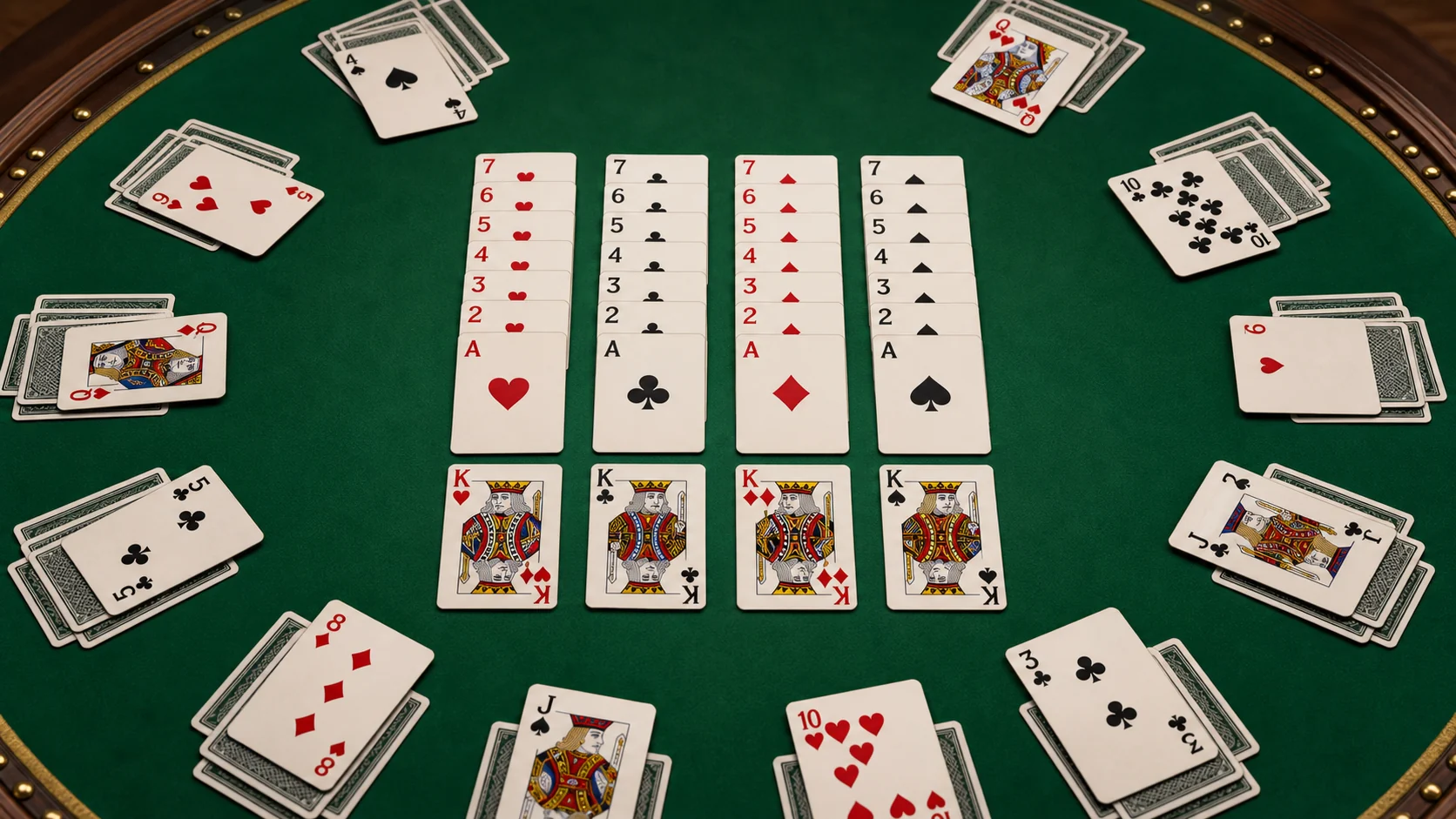
The foundation piles are the engine of Crescent Solitaire. They sit in the center, but they decide what the outer crescent is worth. A tableau move can look clever, a cycle can reveal sixteen fresh top cards, and a pile can be rearranged neatly, but none of it matters unless cards eventually reach the foundations. The center is where progress becomes permanent.
Each suit has two foundation paths. The Ace path climbs from Ace to King. The King path falls from King to Ace. Because the game uses two decks, both paths can be active at the same time. This is what gives Crescent Solitaire its unusual rhythm. Low cards and high cards can both be useful from the first move, while middle cards often wait until one side of the suit catches up.
Think in Suit Lanes
A useful way to read the board is to imagine each suit as a lane with two gates. The low gate starts at Ace and wants 2, 3, 4, and onward. The high gate starts at King and wants Queen, Jack, 10, and downward. When you scan the crescent, do not just ask whether a card can move. Ask which gate wants that card and how close the gate is.
For example, a 7 of Hearts is not immediately useful if the Heart Ace foundation is still at 3 and the Heart King foundation is still at Jack. But it becomes very important if the upward path is already at 6 or the downward path is at 8. The value of a card changes as the center changes.
Middle Cards Need Patience
Middle ranks are easy to mishandle. A 6, 7, or 8 may not have a foundation home for several turns, so players often use it as a convenient tableau mover. That can be right, but only if the move keeps the card available. Burying a middle card beneath a dead top card can starve both foundation directions later.
When a middle card appears, check the matching suit foundations before moving it. If one foundation is close, keep the card near the surface. If both foundations are far away, use it to reveal something useful, but avoid turning it into a prisoner. Crescent Solitaire has no magic rescue pile. Once a key card drops under the wrong top card, you may need a cycle and several lucky moves to see it again.
Do Not Overfeed One Side
Sometimes one foundation path runs smoothly while its partner stalls. That feels good, but it can create a trap. If you send every available card upward and ignore the downward King foundation, the high cards of that suit may clutter the crescent for too long. The reverse is also true. A strong downward run does not excuse neglecting low cards that are ready to climb.
Balanced foundation play does not mean alternating perfectly. It means noticing when one side is doing all the work and the other side is about to block the board. A good Crescent Solitaire player is willing to pause a busy path for one move if that move opens the slower path.
Foundation Timing Before Cycling
Before using a cycle, inspect the center one suit at a time. Ask which exact card each foundation needs next. Then scan the crescent for those eight cards. If any are visible and playable, move them first. If a needed card is one tableau transfer away, make that transfer before cycling. The cycle should solve a shortage, not bury available progress.
Once you start seeing the foundations as eight living targets, the game becomes less chaotic. The crescent stops being a ring of random cards and turns into a supply line. That shift is the difference between moving cards because you can and moving them because the center is ready.
This also makes losses easier to study. When a deal locks, look at the foundation that stalled first and trace the card it needed. If that card was once on top and later buried by a casual tableau move, the lesson is clear. The center tells you which outer cards deserve protection.