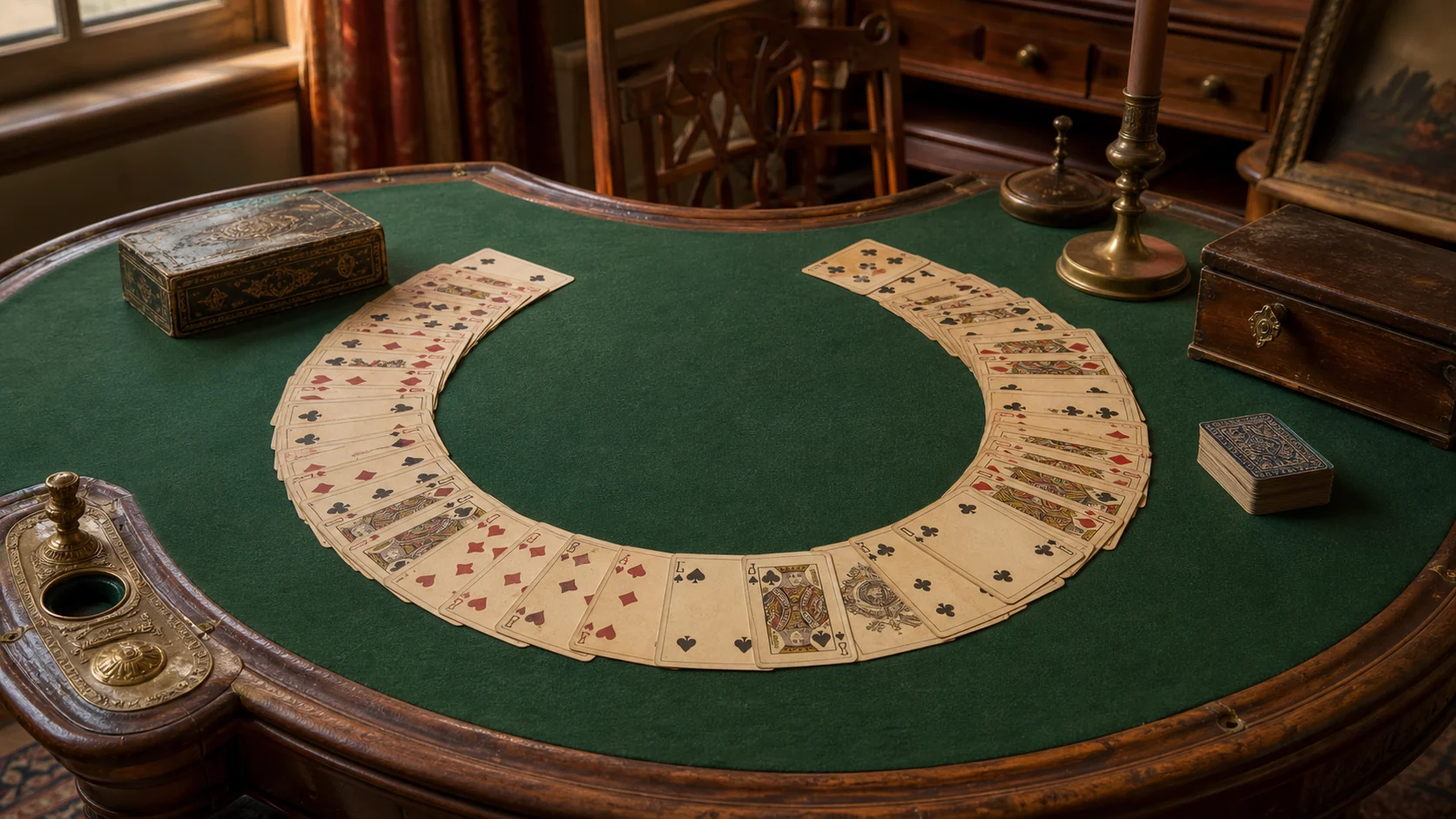
Crescent Solitaire belongs to the broader patience tradition: games designed for one player, one table, and a sequence of decisions that slowly turns disorder into order. Like many patience games, its exact origin is not tied neatly to a single inventor. It developed through rule collections and card-table practice before computer solitaire made lesser-known variants easier to find.
The game stands out because it uses two decks without becoming sprawling. Instead of a long tableau or a deep stock, Crescent Solitaire arranges the work in a curved outer ring and places the real targets in the center. The shape is memorable, but the split foundations are the lasting idea. Building upward from Aces and downward from Kings gives the player useful choices from both ends of each suit.
Digital play helped the game considerably. In physical cards, the crescent takes space and careful handling. In a browser, the layout can be dealt instantly, cycled cleanly, and restarted without fuss. That made the game attractive to players who wanted something more tactical than Klondike but shorter and more visible than many large two-deck patience games.
Modern Crescent Solitaire pages usually emphasize quick access: load the table, make a move, use the limited cycles, and start again when the deal has run its course. That is the spirit behind this site as well. The history matters, but the game is best understood by playing a few hands and feeling how the foundations pull cards out of the crescent.
If you are new to the variant, start with the free Crescent Solitaire game on the homepage, then read the rules once the board has shown you where the pressure lives.