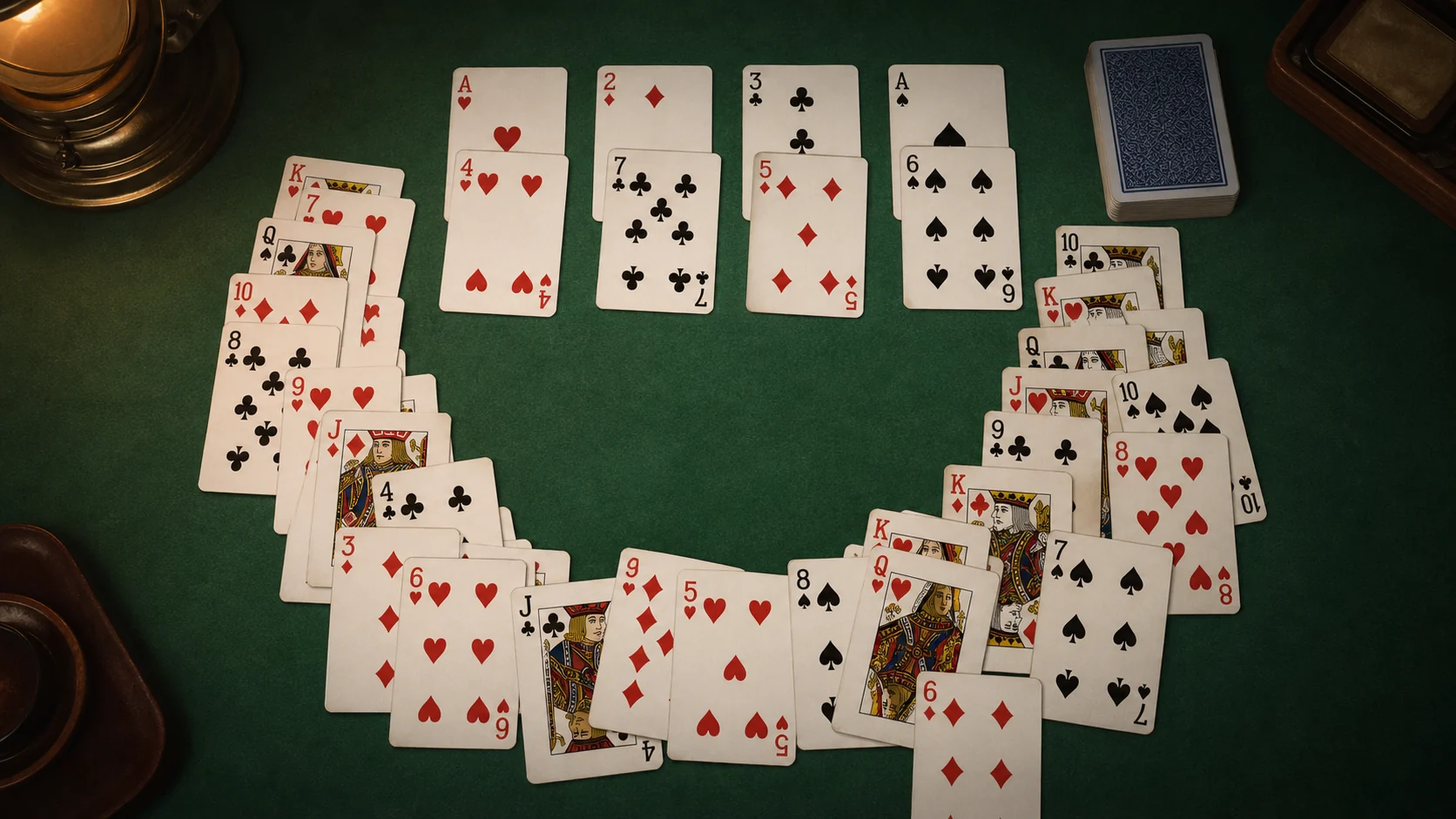
Crescent Solitaire mistakes are rarely dramatic at the moment they happen. Most losing deals are built from small, legal moves that do not improve access. A card is moved because it fits. A cycle is used because the board feels slow. A foundation-ready card is left sitting in the crescent while the player tidies something else. Ten moves later, the deal is frozen and the mistake no longer has a clean name.
The good news is that these habits are easy to spot once you know what they look like. Crescent Solitaire is visible enough to reward discipline. You do not need to guess wildly. You need to stop spending moves on positions that do not help the foundations.
Mistake 1: Cycling Too Early
The cycle button is attractive because it changes the whole table at once. That is exactly why it should be used carefully. If you cycle while useful top cards are still available, you may push those cards away from the foundations and turn a solvable position into a longer chase.
Before cycling, perform a foundation scan. Check every Ace path and every King path. Then check whether a simple same-suit tableau move can reveal one of the needed cards. If the answer is yes, keep playing. Use the cycle when the visible position has been worked, not when you are merely impatient.
Mistake 2: Treating Tableau Moves as Progress
Moving a card around the crescent feels active, but it is not always progress. A tableau move is useful when it reveals a better top card, frees a foundation card, or preserves a suit connection that will matter soon. It is weak when it only covers one card with another and leaves the center unchanged.
A simple test helps: after a tableau move, what new option did you create? If the honest answer is none, you probably made the board harder to read without making it easier to win.
Mistake 3: Ignoring the Slower Foundation
Players often chase the foundation that is already moving. If the Club Ace foundation accepts several cards in a row, it feels natural to keep hunting clubs upward. Meanwhile the Club King foundation may be waiting for a Queen that keeps getting buried. The suit then becomes lopsided, and the crescent fills with cards that have nowhere to go.
Strong play keeps an eye on the slower side. You do not need perfect balance, but you do need awareness. If one path is starved, protect the next card it needs when that card appears.
Mistake 4: Burying Key Middle Cards
Middle cards are easy to undervalue because they may not be playable to a foundation yet. Still, a 7 or 8 can become the hinge between the upward and downward work of a suit. If you bury it under an unrelated card, you may lose access at the exact moment the foundation catches up.
When a middle card is visible, ask whether either foundation is close. If so, keep that card near the surface. If not, use it only for a move that reveals something better.
Mistake 5: Playing Without a Scan
The fastest way to improve is to scan before every cluster of moves. Foundations first. Then top cards by suit. Then cycle count. This does not slow the game much, and it prevents the common slide into random movement.
When a deal fails, the cause is often visible in hindsight: a cycle spent too soon, a card buried for no reason, or a foundation ignored while it was ready. Catch those moments earlier and your win rate will rise without changing the rules at all.
A useful recovery habit is to pause after every reshuffle and rebuild the plan from zero. Do not continue the plan you had before the cycle. The available top cards have changed, and the best move may now belong to a suit you were ignoring a moment ago.