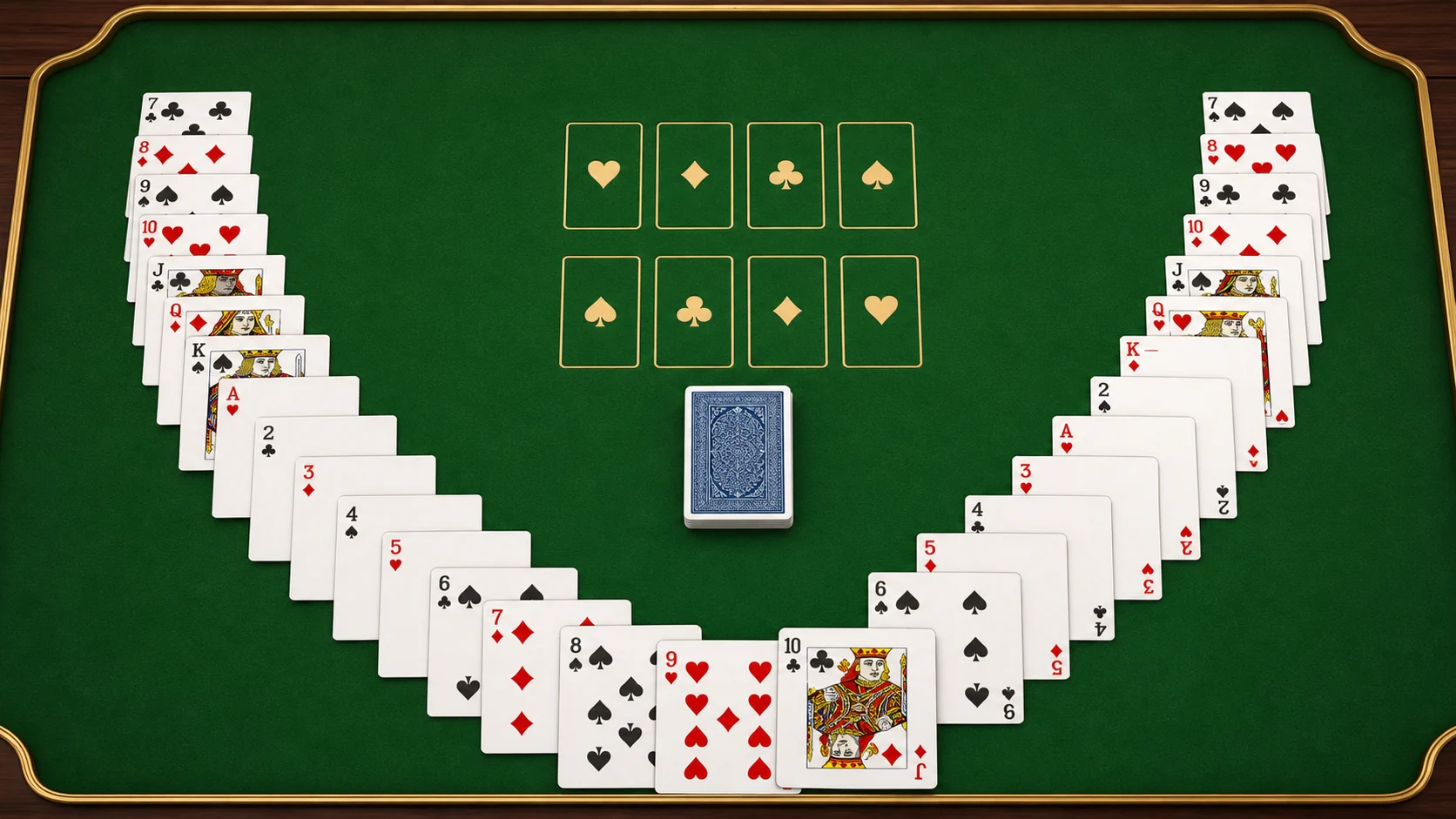
Crescent Solitaire uses two complete decks and asks you to empty a curved outer layout into eight foundations. The shape gives the game its name, but the real character comes from the split foundation system. Four foundations start with Aces and build upward by suit. Four start with Kings and build downward by suit. Every move you make should help one of those paths, even when the card is only traveling through the outer piles for the moment.
At the beginning, one Ace and one King of each suit are placed in the center as foundation bases. The remaining cards are shuffled and dealt into sixteen piles around the center, usually six cards to each pile. The cards in those outer piles are face up, but only the top card of a pile is available. That detail matters. Crescent Solitaire gives you plenty to see, yet it still hides the future behind pile order.
The Goal
The goal is to move all cards from the crescent into the foundations. A card can go to an Ace foundation if it is the next higher card of the same suit. A 2 of Hearts goes on the Ace of Hearts, then the 3 of Hearts, and so on until the King. A card can go to a King foundation if it is the next lower card of the same suit. The Queen of Spades goes on the King of Spades, then the Jack of Spades, and the line continues down to the Ace.
You are not building alternating colors, and you are not collecting cards in a waste pile. The center of the board is the destination. The crescent is the working area where you uncover the next useful top cards.
Many Crescent Solitaire tables also let you move the top card from one foundation path to the other matching path when the rank fits. The original base cards stay fixed, but a movable foundation top can sometimes reopen a blocked suit. Use that option carefully; it is a repair tool, not a reason to undo every foundation decision.
Legal Tableau Moves
The outer piles can also receive cards. A top card may move onto another top card of the same suit if the two ranks are adjacent. That means the 7 of Clubs can move onto the 6 of Clubs or the 8 of Clubs. Many versions also allow the rank connection to wrap between King and Ace in the tableau. Those moves do not complete the game by themselves, but they change which cards are exposed next.
Because only top cards can move, a legal tableau transfer is valuable when it reveals a card that can feed a foundation or create another useful transfer. A move that merely buries an active card under a passive one may look busy without improving the deal.
Reshuffling the Crescent
Crescent Solitaire usually gives you a small number of cycles through the outer piles. A cycle moves the bottom card of each pile to the top. It is not a full redeal and it does not randomize the deck again. It simply changes the available top cards while preserving the pile structure underneath.
Most games allow three cycles. Treat them as a limited resource. Cycling too early can waste a chance to solve the position with visible moves. Waiting too long can also be costly if the board has no productive route left. A good rule is to cycle after you have checked every foundation, every same-suit neighbor, and every pile that can be opened by a simple transfer.
Winning Cleanly
A clean Crescent Solitaire win often feels gradual rather than spectacular. You send a few low cards upward, a few high cards downward, then use tableau moves to expose the next layer. The center grows from both ends while the crescent thins. If you remember one rule, make it this: a move is good only if it helps access. The best players are not the ones who move the most cards; they are the ones who keep the foundations supplied.
Return to the playable Crescent Solitaire table when you are ready to test the rules. The game becomes much easier to read once you have watched the outer piles and central foundations work together for a few deals.